Community leader Nestora Salgado’s life behind bars

dorsetchiapassolidarity's avatardorset chiapas solidarity

Community leader Nestora Salgado’s life behind bars

By Gloria Muñoz Ramírez
Desinformemonos
Translated by Scott Campbell

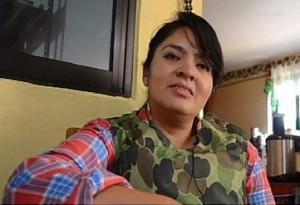
nestora-salgadoDay and night, Nestora Salgado García inhabits a dark world of artificial light. Fifteen days pass without seeing a ray of sunlight. She has no physical contact with anyone, she is only allowed a hug and cannot touch her daughter or her sister when they visit. Not even the guards speak to her. Instead of the four hours every 12 days for visits that she has the right to, after her family members pass the ordeal of security checks, they are left with only two and a half hours. She doesn’t have the recommended medication for the spinal problem she has suffered from for 12 years. In prison, Nestora lives in punishment for her bravery.

Nestora is an activist, a community leader who loudly and unabashedly denounced the local authorities of the municipality of…

View original post 931 more words

Freedom for Nestora/Libertad para Nestora Committee’s Letter to Mexican Deputies

Freedom for Nestora/Libertad para Nestora Committee
5018 Rainier Avenue S., Seattle, Washington 98118, U.S.A.

FreeNestora.org . FreeNestora@gmail.com
March 18, 2014
To the Honorable Deputy Senators Roberto Lopez Suarez, Alejandro Carbajal, Luis Manuel Arias Pallares, Jose Luis Muñoz Soria, Margarita Elena Tapia and Loretta Ortiz Ahft,

The Freedom for Nestora/Libertad para Nestora Committee urges you to take all possible action to help secure the immediate release of Ms. Nestora Salgado. Community leaders in Washington State in collaboration with Ms. Salgado’s family formed the Committee last November and it has since grown into a national and international campaign. Ms. Salgado is a U.S. citizen and a resident of Renton, Washington and there is a growing outcry in this state for her release and dropping the clearly false and politically motivated charges against her.

There have been dozens of radio, TV and newspaper stories about Ms. Salgado in this region of the United States, and the coverage is now spreading nationwide in both the English and Spanish language media. Over 120 organizations and prominent individuals have signed on to support the Campaign to Free Nestora Salgado, including human rights attorneys and organizations, the Washington State Labor Council representing 425,000 affiliated union members, political leaders, Native American indigenous activists, the Seattle Human Rights Commission, the American Federation of State, County and Municipal Employees Council 28 of  Washington, the Martin Luther King, Jr. Celebration Committee, and numerous advocacy organizations from around the country. (A list of the endorsers is attached.) In addition, 6,500 people have signed the online petition urging President Barack Obama to intervene on Ms. Salgado’s behalf.

Legal petitions have been filed with the U.N. Working Group on Arbitrary Detention and the Inter-American Commission on Human Rights. Resolutions and letters from several organizations have been sent to U.S. Secretary of State John Kerry requesting his help obtaining Salgado’s freedom. A multi-city, multinational day of protest and picketing was held on International Human Rights Day, December 10. Protests took place at Mexican consulates in five U.S. cities and government offices in Mexico, the Dominican Republic and Costa Rica. There were also other actions in Australia, France and Argentina.
Last week International Women’s Day press conferences, forums and rallies were held in New York City, San Francisco and Seattle, as well as in Mexico, where supporters and family members of Nestora Salgado demanded her release.

The Freedom for Nestora Committee is currently following up with the U.S. Congressional delegation from Washington State in order to insure more aggressive intervention by the U.S. Secretary of State on Ms. Salgado’s behalf.
It is becoming increasing clear to us and to the broader U.S. public that Ms. Salgado is guilty only of trying to help the people of her hometown of Olinalá, where she is a respected community leader. We are also gravely concerned about the fate of Ms. Salgado’s colleagues in the Community Police Force in Guerrero who have been persecuted for carrying out their duties and for protesting Nestora Salgado’s arrest.

We heartened to hear that your esteemed body is investigating Ms. Salgado’s incarceration and mistreatment, and look forward to hearing the results of your inquiry.  If we can provide any more information that would assist your efforts, please contact us at the above address or email.


Sincerely,
Su Docekal

Chairperson,

Freedom for Nestora/Libertad para Nestora Committee

Seattle, Washington

The Right to Arm Oneself

By Cuauhtémoc Ruiz Ortiz, Partido Obrero Socialista, Mexico

The appearance of community police and self defense groups, in eleven states of the country, is one of the more amazing events of recent years in Mexico.

Thousands of people have been obliged to arm and organize themselves against narcos and criminals that extort and abuse them.

The enormous majority of these police and self defense groups are people from humble conditions–peasants, agricultural and farm workers, small and medium sized business people.

Where these community guards have existed they have been successful and considerably lowered criminality.

In Michoacan, the  performance of the self defense groups has been spectacular because in the month of December and the beginning of 2014 they have pursued and driven out the criminals from the cities and towns where they were hidden.

This popular determination to stop the criminals has turned into a energetic, quasi-military campaign with territories that the self defense groups liberate to the joy of the people.

The combatants understand that it is not enough to expel the criminals from their communities and that it is necessary to exterminate them and take them from their hiding places.

In the state of Guerrero, even though it is not so spectacular, the organization of the community police has advanced toward Chilpancingo and has important popular support.

This brave fight of the armed and organized people has highlighted the fact that the false war of (former president) Felipe Calderon against the narcos was a failure.

It was precisely in Michoacan where the then president initiated, in December 2006, the operations that supposedly were fighting against the criminals. Six years later, the Michoacan narcos were more powerful and shameless, and, in the country, were more than 70 thousand cadavers.

Michoacan in 2014 equally demonstrates the failure of the present President Peña Nieto in the matter of security. The leaders of the PRI knew that the narcos were kings in Michoacan but they tolerated and collaborated with them. Only the energetic action of the armed popular movement obliged the intervention of the federal government, more worried because the state government (in charge of the tricolor) was totally losing control before the organized people. Michocan and Guerrrero equally show that the PRD has suffered a strong set back.

In both states,  the yellow party governed  or governs  or (former presidential candidate) Lopez Obrador has a strong influence. The latter on February 10 spoke in defense of the prisoners in Guerrero–six months after they had been imprisoned!–but
not even this for Michoacan.

And never has been heard from the PRD a sympathetic word for the offended people and the important persons of the PRD are suspected of being narcos. The governor of Guerrero, from the PRD, is a ferocious repressor of the communitarios (community police)

Libertad a Nestora

Magdalena Gómez

Justamente en estos días que lamentamos el fallecimiento de Luis Villoro, lo recuerdo cuando en los tiempos de los diálogos de San Andrés, en Chiapas, me preguntó de pronto: Si tú y yo no somos indígenas, ¿por qué estamos aquí? Sin dar tiempo a mi reacción, como buen filósofo, de inmediato se respondió con fuerzaporque no queremos ser cómplices. Siempre lo recuerdo porque esa es la aspiración de fondo que guardamos quienes nos comprometimos por lograr un México donde en efecto quepan muchos mundos, muchas culturas, muchos pueblos y lo hagan con la dignidad como premisa.

En ese contexto ubico mi reflexión. De tantas impunidades que coexisten en nuestro país, de pronto parece que a seis meses de la reclusión y aislamiento en un penal de alta seguridad en Tepic, Nayarit, de la comandanta de la policía comunitaria en Olinalá, Guerrero, Nestora Salgado, el Estado ha logrado el objetivo de que se pierda nuestra atención en redoblar la exigencia sobre su liberación. Acusada de secuestro agravado, se ha mantenido hermetismo sobre los fundamentos de tal imputación: si bien en especial su familia ha denunciado las múltiples violaciones al debido proceso que rodearon su aprehensión, ésa sí ejecutada como un virtual secuestro. Sólo la dimensión de la violación a sus derechos humanos individuales sería suficiente para sustentar la decisión de liberarla, además de contar con doble nacionalidad, pues fue migrante en Estados Unidos durante muchos años y ese gobierno también debería mostrar interés en su situación, pero no estamos hablando de una ciudadana francesa muy conocida y muy influyente. Sin embargo, el eje de este caso radica en un elemento que debería ser central en su defensa y en la valoración del Poder Judicial: Nestora Salgado realizó actos de autoridad como comandanta de la policía comunitaria. ¿A qué me refiero?

Seguir leyendo en La Jornada >>

Radical Women: International Women’s Day Celebration

A great Seattle event honoring International Women’s Day and Nestora.

sheswithmeseattle's avatarShe's With Me

When: Friday, March 14, 7:00 pm
Where: New Freeway Hall, 5018 Rainier Ave S., Seattle, WA 98118
Cost: $2 donation, $7 for snacks

International Women’s Day: Sisters Stand Up to Political Repression and Mass Incarceration Public celebration will honor grassroots movements mobilizing to free political prisoners and end wrongful convictions. Radical Women will highlight cases being fought by Marissa Alexander, Rasmea Odeh, Nestora Salgado, and Lynne Stewart.

View original post

México: Nestora Salgado escribe desde prisión con motivo del Día Internacional de la Mujer Trabajadora

Mensaje de la comandante Nestora a las mujeres, en su día internacional en voz de su hermana Cleotilde Salgado

Me llamo Nestora Salgado García, tengo 42 años, tres hijas y cuatro nietos y una nieta. Estoy injustamente en la cárcel desde el 21 de agosto del año pasado. Aunque estoy encerrada y quieren abatirme mis captores, me dirijo con optimismo a lasmujeres en su día internacional. Este es un mensaje a lasmujeres de México y Estados Unidos, también a las mujeresde otros países en los que sufren discriminación. Mi mensaje a las mujeres es que no se dejen, que protesten y luchen si creen que son humilladas ya sea en su trabajo, en su localidad o en su misma casa.

La vida para las mujeres en países como México es muy difícil, sobre todo si somos de familias campesinas y de pueblos como el mío en medio de las montañas de Guerrero, estado donde siempre ha habido mucha pobreza y falta de todo tipo de servicios. También siempre ha habido mucha corrupción y abusos de los gobernantes.

Seguir leyendo en kaosenlared.net >>

Statement by Nestora Salgado on International Women’s Day 2014

My name is Nestora Salgado García. I am 42 years old and have three daughters and four grandchildren. I have been unjustly jailed since August 21 of last year. Even though I am jailed and my captors want to break me, I speak to you with optimism on this International Day Women’s Day 2014.

This is a message to the women of Mexico and the United States, as well as the women of other countries where women suffer discrimination.

My message is to resist, to protest and to fight whenever you find yourself humiliated in your place of work, your community or even in your own home

The life of women in countries such as Mexico is very difficult, above all in campesina families and communities like mine in the mountains of Guerrero, a state which has always had a lot of poverty and inadequate levels of all types of services. Guerrero also has suffered a lot of corruption and abuse at the hands of government officials.

I have always worked to take care of my daughters, the first of whom was born when I was 16 years old. I had to emigrate from Mexico to the United States where I worked doing many things like cleaning houses and working as a waitress in restaurants. Through my own efforts, I managed to become a U.S. citizen. But I never forgot my roots, my parents, my brothers and sisters and my family who I frequently visited. Neither did I forget my community. I could not remain indifferent to what was taking place with my neighbors and in my hometown of Olinalá, which unfortunately was happening in other places in our cherished Mexico.

The abuses of organized crime had become commonplace every day. It had become impossible to live in peace. We could not leave our houses. We could not work, travel, mount a business or confidently send our children to school. We could not go to the town square in peace and enjoy an ice cream. So, the community suddenly organized itself and elected me as its representative. I became the coordinator of Olinalá community police.

In the beginning, the government officials supported the community police. The governor of Guerrero provided us with two vehicles and other support. We also received official documents designating us as community police.

As the community police, we did our job and we did it well. We served the community of Olinalá. We confronted organized crime and those who supported it. In the first year, the index of major crimes dropped by 90%. Maybe this is why the government ended up attacking us and taking me into custody together with 12 other CRAC (Regional Coordination of Community Authority- Community Police) in Guerrero.

I was arrested in an impressive display of military and police force, greater than any used previously in apprehending the worst drug traffickers. Within hours, I was sent to a high security prison in Nayarit where I am currently held as if I were a dangerous animal.

I am isolated from all the other inmates. One of my daughters and one of my sisters can only visit me every two weeks. I cannot speak to anyone. I never see the sun or enjoy sunshine. I receive none of the pain medication I need due to a car accident I suffered. I am allowed no magazines or newspapers. I cannot even receive a letter from my husband who is in the United States, nor a drawing from one of my grandchildren. I am allowed only a few minutes of conversation with my daughter Zaira. I cannot watch television.

I know they want to break me but this will not happen. I know that in locking me up they want to send a message to all the women and men in Mexico standing up against injustice. But they will not break me. I will never ask for forgiveness from my jailers. I have no reason to ask from anyone, especially the Mexican government. Out of my mouth and from my heart, you will hear only words of encouragement for all those who, like me, have committed themselves to accomplishing something for their communities and their families.

I want to speak especially to the women–to the wives and the mothers of the other imprisoned other community police. I say we will endure the cold prison. And we believe that the day is near when we will be free.

To all women, I say: Do not give in to anything or anyone. Do not tolerate any corrupt government official or mafia criminal. Do not tolerate discrimination or mistreatment from anyone.

To the women of Olinalá, I ask that you continue the struggle that we began a year ago with our husbands and neighbors.

My captors are piling up charges against me. But I know that in the end I will walk out of this jail. I will do so with my head high because I know that no one believes that I am a criminal. There are honest people in Mexico, in the United States and other countries who know that I am a political prisoner.

I will leave prison to take up once against the struggle for community police that I initiated.

Onward women of Mexico and the world! History teaches us that sacrifices are necessary to accomplish what we want. Let us stand fearless and determined to do away with evil and those who support it. This is how we women will build a bright and better future.

–From the high security prison in Tepic, Nayarit, March 7, 2014

Reprinted by:  Libertad para Nestora/Freedom for Nestora–Seattle Committee
FreeNestora.Seattle@gmail.com . 206-722-2453 . Facebook.com/FreeNestora
5018 Rainier Ave. S., Seattle, WA 98118